Small Mechanisms, Big Differences
The most dependable tools in a kitchen or workshop rarely contain circuit boards. Instead, they exploit invariant laws of physics: the unequal thermal expansion of two metals bonded together, the linear relationship between spring extension and restoring force, or the centrifugal acceleration of dust spinning inside a cone. When an inventor pairs the right physical property with a simple stamped lever, the resulting mechanism works the same way on its ten-thousandth cycle as it did on day one.
Four Everyday Mechanisms Dissected
The Anglepoise Lamp & Human Muscle Mimicry
Automotive suspension engineer George Carwardine was testing helical springs that exhibited a "zero-free-length" characteristic—meaning the tension is directly proportional to the total length of the spring. He realized that if you attach three such springs across a triangular bell-crank lever connected to a four-bar parallelogram arm, the upward pull of the springs changes at the exact mathematical rate as the downward gravitational torque of the extended lamp shade.
Because the gravitational moment ($M = m g L \cos\theta$) and the spring restoring moment cancel each other at every angle, you don't need wingnuts or friction clutches. Touch the shade with one finger, move it anywhere within a 90-centimetre hemisphere, and friction in the pivot pins is enough to hold it still.

The Steam-Triggered Bimetallic Snap Disc
Early electric kettles destroyed themselves if left unattended until Russell and Hobbs introduced the K1 automatic kettle in 1955, later perfected into the cordless 360-degree Strix control by John C. Taylor. Why not use a standard thermostat in the water? Because atmospheric boiling point varies with altitude and barometric pressure, and mineral scale fouls submerged sensors.
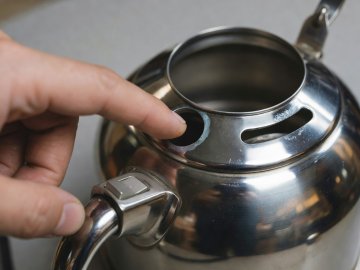
Instead, a narrow chimney channels buoyant steam from the top of the kettle chamber down to a stamped bimetallic blade under the base. Only when water reaches a vigorous rolling boil does steam flood that duct, heating the brass/invar disc past 85 °C so it snaps inside-out like a toy clicker and physically kicks open the mains contacts.
Fluid Shear Inside Concealed Soft-Close Hinges
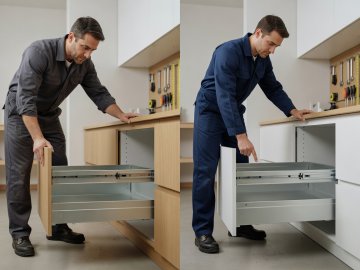
A spring-loaded cabinet hinge wants to accelerate the door right up until impact. Adding a rubber bumper only muffles the noise; it does not slow the door down. Integrating a miniature hydraulic damper into the 35-millimetre hinge cup solved the problem by pairing a mechanical over-centre spring with a viscous silicone fluid chamber.
During the final 20 degrees of closure, the hinge arm depresses a tiny plunger that forces dimethylpolysiloxane fluid past a tapered metering pin. If a child flings the door shut, fluid shear resistance spikes immediately, braking the door to a uniform two-second glide.
The Self-Scouring S-Bend and U-Trap
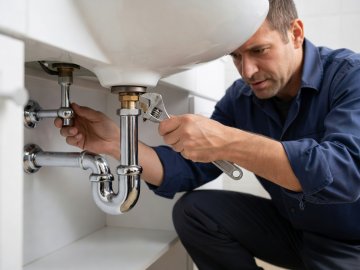
Before 1775, indoor drainage pipes led straight to cesspits, turning homes into chimneys for methane and hydrogen sulphide. Mechanical check valves failed within weeks because hair, soap fats, and grit wedged the hinge open. Cummings realized that water itself is an airtight, self-healing gasket.
By bending the waste pipe into a vertical dip at least 50 millimetres deep, every flush sweeps old water over the weir and leaves a fresh plug behind. There are zero moving parts to wear out, and the seal automatically resets every time you wash your hands.
Comparison of Household Control Mechanisms
How purely physical actuators compare against electronic sensors in damp or high-cycle domestic environments.
| Everyday Device | Physical Mechanism | Primary Material Property | Typical Lifespan (Cycles) |
|---|---|---|---|
| Cordless Electric Kettle | Bimetallic Snap-Action Disc | Differential thermal expansion (Brass vs. Invar) | 50,000+ boils |
| Anglepoise Task Lamp | Constant-Tension Helical Linkage | Hooke's law elastic spring modulus | 100,000+ adjustments |
| Soft-Close Cabinet Hinge | Metered Orifice Rotary Damper | Silicone oil kinematic viscosity stability | 80,000–200,000 closures |
| Thermostatic Radiator Valve (TRV) | Wax-Filled Bellows Capsule | Phase-change volumetric expansion of paraffin wax | 20+ years continuous |