More Than One Job
Good multifunctional furniture obeys a strict usability rule: if converting a piece from daytime mode to nighttime mode takes longer than thirty seconds or requires moving three other items out of the way, the owner will stop folding it within a month. The enduring classics of compact living—from Eileen Gray's 1927 pivoting cabinets to Bruno Mathsson's ultra-thin gateleg tables—rely on low-friction tracks, offset hinges, and balanced weights so conversion feels effortless.
Mechanisms That Reclaim Floor Area
The Maria Flap Gateleg Table & Splayed Leg Geometry
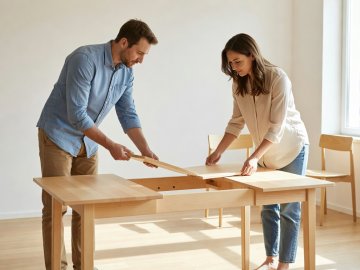
Traditional 17th-century oak gateleg tables had a frustrating flaw: wherever you pulled up a chair, a swinging wooden gate leg bruised your knees. Swedish modernist Bruno Mathsson re-engineered the geometry in 1935 with the Maria Flap table. By using laminated birch leaves hinged to a central spine only 14 centimetres wide, and pivoting two slender V-shaped support legs from the very centre of the spine rather than the outer corners, six diners get unobstructed legroom.
When dinner ends, both leaves drop vertically and the entire dining table can be lifted with one hand and stored flat behind a bookshelf.
Pivoting Drawers & The E-1027 Adjustable Table
Designing her cliffside house E-1027 on the French Riviera, architect Eileen Gray rejected bulky chests of drawers that required deep floor clearance to pull open. Instead, she stacked wooden storage boxes around a single vertical steel pole at one corner. A gentle push swings the entire drawer tray out in a circular arc with zero runner friction.
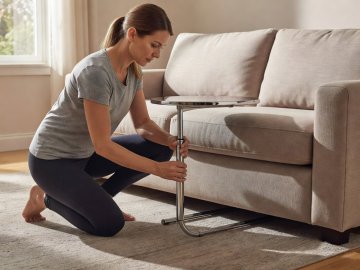
For her famous tubular-steel side table, Gray built a telescopic stem secured by a tethered steel pin on a fine chain, allowing the C-shaped base to slide completely underneath a sofa frame while bringing the tabletop directly over a reader's lap.
Tambour Roll-Top Shutters for Zero-Clearance Aisles
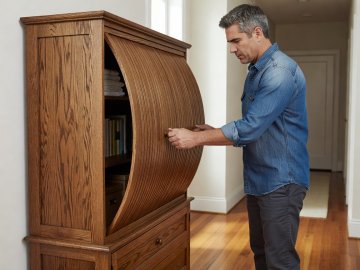
In a narrow galley kitchen or hallway, a 60-centimetre hinged cupboard door blocks the entire walkway when open. Jean-François Oeben and Jean-Henri Riesener solved this in 1760s writing desks by gluing narrow bevelled hardwood slats side-by-side onto heavy linen canvas.
Guided by a routed groove in the cabinet sides, the tambour door curves effortlessly around a 6-centimetre corner radius and disappears along the back panel of the cupboard, requiring zero swing space in the room.
Full-Extension Riser Drawers & Pull-Out Under-Stair Pantries
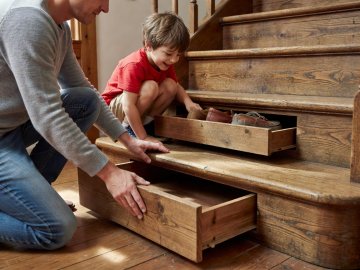
The triangular space beneath a staircase (the spandrel) is notorious for becoming a dark cave where only the front 30 centimetres can be reached. Fitting heavy-duty three-stage telescopic ball-bearing runners—rated for 90 kilograms per pair—allows the entire triangular volume to roll out into the hallway as vertical apothecary racks, while individual stair risers open on push-to-release latches for shoes and tools.
How to Judge a Space-Saving Furniture Piece Before Buying
1. Count the setup steps (The 15-Second Rule)
If a sofa bed requires removing four cushions, storing them on the floor, unclipping a fabric skirt, and wrestling a trampoline frame, it is a guest bed—not an everyday sleeper. Look for mechanisms where cushions stay attached to the frame and fold underneath in one continuous motion.
2. Check how hardware handles racking loads
Folding tables and wall desks fail when people lean their elbows on the outer edge, creating a high lever arm on small screws driven into particleboard. Insist on solid hardwood or multi-ply birch cores with bolted through-fasteners or floor-reaching gatelegs.